

Have a question about Breast Augmentation?
In this article
- Can you breastfeed after breast augmentation with implants?
- What parts of the surgery make breastfeeding easier or harder?
- Do implants affect milk supply, nipple sensation or milk safety?
- If you have not had surgery yet, what should you ask before breast augmentation?
- What if you are pregnant now or trying to breastfeed after implants?
- What should international patients know before travelling for surgery if breastfeeding matters later?
Many patients ask, can I breastfeed after breast augmentation with implants, especially if they have not had children yet or plan pregnancy later. It is a sensible question, because the answer depends less on the implant itself and more on how the breast surgery was done, how your breast tissue develops in pregnancy, and how your body responds afterward.
Can you breastfeed after breast augmentation with implants?
Often, yes. Many women are able to breastfeed after breast augmentation, but it is not something any surgeon can promise in advance. Breastfeeding depends on milk glands, milk ducts, nerves around the nipple, hormonal changes after birth, and how well the baby latches. Surgery is only one part of that picture.
Mayo Clinic notes that breast surgery can affect the nerves and ducts involved in milk production and milk release, and that implants placed below the chest muscle tend to interfere less with breastfeeding than surgery that directly disrupts glandular tissue. The Centers for Disease Control and Prevention also explains that most mothers who have had breast or nipple surgery can produce at least some milk, though some may not make a full supply.
That uncertainty matters. Some patients breastfeed without obvious difficulty after implants. Others can breastfeed partly but need formula or donor milk as well. A smaller group struggle with supply, nipple sensation, or milk let-down. The main point is that implants do not automatically mean you cannot breastfeed, but they do mean your individual result is harder to predict.
A 2019 study in Aesthetic Surgery Journal that followed more than 3,500 women after primary augmentation found that many women did go on to breastfeed after both silicone and saline implant surgery. The most commonly reported issue was low milk production, which is also a common breastfeeding problem in women who have never had breast surgery. That is why it is important to be careful with cause and effect: if breastfeeding is difficult later, implants may be part of the story, but they are not always the whole explanation.
📋 What matters most The ability to breastfeed is influenced by incision location, implant placement, nipple sensation, breast anatomy before surgery, pregnancy-related breast changes and normal variation in milk supply.
What parts of the surgery make breastfeeding easier or harder?
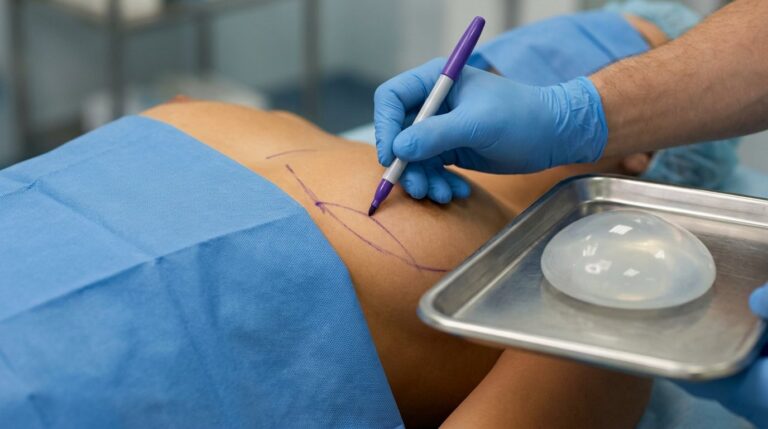
The surgical details matter more than the filler inside the implant. In practical terms, the biggest issues are where the incision is made and how much the operation affects the nerves and ducts behind the nipple.
An incision placed in the fold under the breast is generally thought to pose less risk to breastfeeding structures than an incision around the lower edge of the areola, because the areola approach may pass closer to nerves and ducts. That said, real-life outcomes still vary, and not everyone with a periareolar incision has breastfeeding problems. A 2007 study in Aesthetic Plastic Surgery looked at changes in breast and nipple sensibility after augmentation and highlighted that sensation changes can vary by technique and by the relation between implant size and the natural breast.
Implant placement also matters. When the implant is placed under the chest muscle, called submuscular placement, there is usually less direct disruption of milk-producing tissue than when surgery is more closely tied to the breast gland itself. This does not guarantee normal lactation, but it is one reason some surgeons prefer that approach in patients who strongly want to preserve future breastfeeding potential.
Your starting breast anatomy matters too. Some patients seeking augmentation have very little glandular tissue to begin with, and that can affect milk supply regardless of surgery. This is one reason the answer can be less straightforward in patients with marked breast underdevelopment, asymmetry, or tuberous breasts. In those cases, reduced milk production may relate to both anatomy and surgery rather than one factor alone.
Techniques that avoid unnecessary disruption around the nipple and preserve breast tissue as much as possible are generally preferred.
Even with a careful technique, no surgeon can guarantee full milk supply later because pregnancy, hormones and natural breast anatomy also play major roles.
Do implants affect milk supply, nipple sensation or milk safety?
These are really three separate questions, and patients often hear them blended together.
First, milk supply. Supply can be lower after augmentation if surgery affects nerves, ducts, or functional breast tissue. It can also be lower for reasons unrelated to implants, such as hormonal conditions, poor latch, infrequent feeding, early formula supplementation, or naturally limited glandular tissue. According to the CDC, some mothers after breast surgery make a full supply and some make only part of what the baby needs. That range is normal to discuss openly.
Second, nipple sensation. Feeling in the nipple matters because the nerves there help trigger the hormonal reflex for milk let-down. If sensation is reduced after surgery, breastfeeding can still be possible, but the process may feel different and let-down may be less efficient for some patients. Sensation can improve over time, but recovery is variable. Some people notice changes only for weeks or months, while others have longer-lasting numbness or sensitivity changes.
Third, milk safety. Available evidence does not show that having silicone or saline implants means breast milk is unsafe in a general sense. Mayo Clinic states that there is not enough evidence to say silicone from implants causes harm through breastfeeding. The concern for most patients is therefore function rather than contamination: can you make enough milk, and can milk flow well enough for feeding to work?
A 2010 study in Annals of Plastic Surgery compared breastfeeding outcomes in women with saline implants and a comparison group with small natural breasts. It found that breastfeeding difficulties did occur, but the picture was more nuanced than a simple yes-or-no answer. That is often the most honest way to discuss this topic: many patients can breastfeed, some need support or supplementation, and a minority cannot produce enough milk for exclusive feeding.
⚠️ Be cautious with online anecdotes One person’s easy breastfeeding story or difficult one does not predict your own outcome. Breastfeeding after augmentation is highly individual.
If you have not had surgery yet, what should you ask before breast augmentation?
If future breastfeeding matters to you, bring it up early and directly. This should shape the planning conversation, not be added as an afterthought at the end of a cosmetic consultation.
Ask how the planned incision may affect ducts and nerves, whether the implant is likely to sit under or over the muscle, and whether your natural breast anatomy raises any extra concern about future milk production. If you already have limited nipple sensation, marked breast asymmetry, tuberous breast shape, or signs of low glandular tissue, those points deserve a fuller discussion because they may affect breastfeeding even without surgery.
It is also worth asking what trade-offs come with technique changes. A plan chosen to better protect future lactation may not be identical to the plan chosen only for shape, cleavage, or scar placement. There is no single perfect approach for every patient.
The American Society of Plastic Surgeons advises patients to choose a properly qualified plastic surgeon and discuss future pregnancy and breastfeeding goals before surgery. For patients researching the procedure itself, a general overview of breast augmentation surgery can help frame the terminology, but the breastfeeding conversation has to be personal rather than generic.
- ✓Tell the surgeon clearly if future breastfeeding is important to you.
- ✓Ask which incision is planned and why.
- ✓Ask whether the operation is expected to disturb tissue behind the nipple.
- ✓Ask how your current breast anatomy may affect later milk supply.
What if you are pregnant now or trying to breastfeed after implants?
If you already have implants and are now pregnant, the most useful step is realistic planning. You do not need to assume breastfeeding will fail, but it helps to know early that milk supply and nipple sensation may be different from person to person.
After birth, watch the practical signs rather than guessing. Is the baby latching well? Is swallowing audible? Is weight gain on track? Are nappies wet often enough? A lactation consultant can be especially helpful in the first days if you have had any breast surgery, because low supply is easier to address when identified early.

Some mothers with implants exclusively breastfeed. Others combine breastfeeding with formula or donor milk. That does not mean you have failed. It means feeding is being adjusted to what your body and baby need.
You should also seek medical review if one breast becomes very swollen, red, hot, or sharply painful, if you develop fever, or if you think an implant shape has changed significantly during pregnancy or after delivery. Those symptoms may suggest a breastfeeding problem such as mastitis, but they can also raise a separate breast or implant concern.
Revision surgery is a different question. Some women notice aesthetic changes after pregnancy and breastfeeding and later consider a lift, implant exchange, or revision. Others do not. There is no reliable way to predict that beforehand, and not every post-pregnancy change needs another operation.
If milk supply is lower than hoped, combination feeding may still allow bonding and some breast milk benefits while supporting the baby’s growth.
What should international patients know before travelling for surgery if breastfeeding matters later?
If you are travelling abroad for augmentation and future breastfeeding is one of your priorities, the key issue is not tourism convenience but pre-operative planning and access to follow-up. You need enough time before surgery for a proper discussion about incision choice, implant position, sensation risks, and what can and cannot be predicted.
Choose a surgeon with recognised training and registration, and look for clear professional standards rather than marketing language. EBOPRAS is one recognised European board body in plastic surgery, and ASPS also emphasises the importance of specialist qualifications and informed consent. Ask who will do the operation, who handles aftercare, and how you would be supported if you later develop persistent numbness, asymmetry, or concerns during pregnancy.
Cost also deserves a practical conversation, but it should stay personalised. The final quote usually depends on the surgeon’s fee, hospital or operating facility, implant type, anaesthesia, garments, medication, and aftercare arrangements. If you are comparing countries or clinics, make sure you are comparing like with like, especially around follow-up, revision policies, and what happens if you return home before all swelling settles.
For travel planning, many patients want to know how long they need to stay. That depends on the surgeon’s protocol, your recovery, and whether there are early concerns that need review before flying home. A longer stay can be sensible when careful post-operative checks matter.
This article is for informational purposes only and does not constitute medical advice. Always consult a qualified surgeon for personalised guidance.
🚨 Red flag when choosing a surgeon Be cautious if anyone guarantees you will definitely breastfeed normally after augmentation. That outcome cannot be promised.
Frequently Asked Questions
References
- 📎Breastfeeding after augmentation mammaplasty with saline implants — Annals of Plastic Surgery, 2010
- 📎Lactation Outcomes in More Than 3500 Women Following Primary Augmentation: 5-Year Data From the Breast Implant Follow-Up Study — Aesthetic Surgery Journal, 2019
- 📎Tuberous breast deformity correction: Long-term satisfaction assessment with BREAST-Q questionnaire — Annales de Chirurgie Plastique Esthétique, 2021
- 📎The impact of parity in primary breast augmentation: A clinical and cost-effective case control study — Journal of Plastic, Reconstructive & Aesthetic Surgery, 2022
- 📎Relative implant volume and sensibility alterations after breast augmentation — Aesthetic Plastic Surgery, 2007
- 📎Cosmetic procedures — American Society of Plastic Surgeons
- 📎Cosmetic procedures — NHS
- 📎Tests and procedures — Mayo Clinic
- 📎EBOPRAS
Related Articles



You Might Also Like



Related articles


Our specialists
 Clineca SpecialistErkan PinegözPlastic & Reconstructive Surgery
 Clineca SpecialistHakan AktaşPlastic & Reconstructive Surgery
 Clineca SpecialistOrkun UzuneyüpoğluPlastic & Reconstructive Surgery
 Clineca SpecialistSalim İskenderPlastic & Reconstructive Surgery
 Clineca SpecialistEngin SelamioğluPlastic & Reconstructive Surgery
 Clineca SpecialistCem AydınPlastic & Reconstructive Surgery
 Clineca SpecialistAlperen ÖnalEar, Nose & Throat (ENT)