

Have a question about Breast Implant Surgery?
In this article
- What does capsular contracture usually feel and look like?
- When do the signs start, and can they appear years later?
- How is capsular contracture different from normal healing or implant rupture?
- When should you seek urgent review?
- What treatment options are there if it is capsular contracture?
- What affects the cost and travel planning for revision surgery?
- How long is recovery after implant removal or replacement for contracture?
- How do you choose a safe surgeon or clinic for capsular contracture treatment?
- What is the practical next step if you think you have capsular contracture?
The main signs of capsular contracture after breast implants are increasing firmness, a breast that sits higher or looks more round or distorted, discomfort or tightness, and changes that do not settle with time. If you are asking what are the signs of capsular contracture after breast implants, the short answer is that a breast can start to feel hard, look misshapen, and sometimes become painful — but these symptoms can overlap with other implant problems, so a proper surgical assessment matters.
What does capsular contracture usually feel and look like?
A thin scar capsule around a breast implant is normal. The problem starts when that capsule tightens and squeezes the implant. Over time, the breast may feel firmer than before, less natural to the touch, or uncomfortable when you lie on your side, hug someone, exercise, or wear a bra.

Many people first notice a visual change rather than pain. One breast may begin to sit higher, look more round or overly pushed up, or seem less mobile than the other side. The breast can also look distorted, especially at the lower pole, meaning the fuller lower part of the breast no longer hangs in the way it used to.
Pain is possible, but not everyone has it. Some people describe pressure, tightness, or a pulling feeling rather than sharp pain. If the contracture becomes more advanced, the breast can feel quite hard and look clearly different from the other side.
Doctors often describe capsular contracture by severity using the Baker scale. You do not need to memorise it, but it helps explain why one patient has mild firmness while another has obvious distortion and discomfort.
- ✓Baker I: soft, natural-feeling breast
- ✓Baker II: slightly firm, still looks normal
- ✓Baker III: firm and looks distorted
- ✓Baker IV: hard, distorted, and painful
General patient guidance from recognised medical bodies such as the NHS and Mayo Clinic advises getting checked if you develop new, persistent breast changes after implant surgery, especially firmness, pain, swelling, or shape change rather than assuming it is a normal fluctuation.
⚠️ Do not self-diagnose from photos alone A hard or misshapen breast can be caused by capsular contracture, but also by implant rupture, malposition, fluid collection, or natural asymmetry. An in-person assessment is the safe next step.
Capsular contracture happens when the scar tissue that normally forms around an implant tightens too much. The most common signs are firmness, a breast that feels unusually hard, shape distortion, a higher-riding implant, tightness, and sometimes pain. In mild cases the change is subtle; in more advanced cases it is obvious.
When do the signs start, and can they appear years later?
Timing can be confusing because breasts are often swollen and firm in the early weeks after augmentation or reconstruction. That early firmness usually improves as healing settles. Capsular contracture is more concerning when the breast becomes progressively harder, starts to ride high, or looks increasingly different after an initial period of normal healing.
Yes, it can happen years later. A breast that felt soft for a long time can change after a silent implant problem, bleeding around the implant, infection, trauma, or sometimes with no single obvious trigger. That is why a new change, even many years after surgery, should not be brushed off as “just ageing”.
If only one breast is changing, that is especially worth checking. Capsular contracture often affects one side more than the other, so increasing asymmetry can be a clue. Some patients notice they can no longer wear the same bras comfortably, or that cleavage and upper-pole fullness look different in photos.
A 2025 study in Aesthetic Plastic Surgery looked at patients treated surgically for capsular contracture and analysed risk factors for early complications after that surgery. It does not tell us that every firm implant is contracture, but it does reinforce an important practical point: once contracture is significant enough to need surgery, careful planning and patient selection matter.
Capsular contracture can appear within months of surgery, but it can also show up years later. Early swelling and firmness are common in normal recovery, so the pattern matters: symptoms that worsen, return after settling, or affect only one side deserve review rather than watchful waiting.
How is capsular contracture different from normal healing or implant rupture?
Right after surgery, it is normal for the breasts to feel tight, swollen, and a little high. That early stage should move in the right direction. If instead the breast stays very firm, starts becoming more uneven, or grows more uncomfortable, it is reasonable to ask whether this is more than routine healing.
Implant rupture can look similar, especially when shape changes. With saline implants, a rupture often causes noticeable deflation. With silicone implants, changes can be much more subtle, which is why a scan may be advised. The point is not to guess the exact cause yourself. It is to recognise that a new hard or distorted breast is a review-worthy symptom.
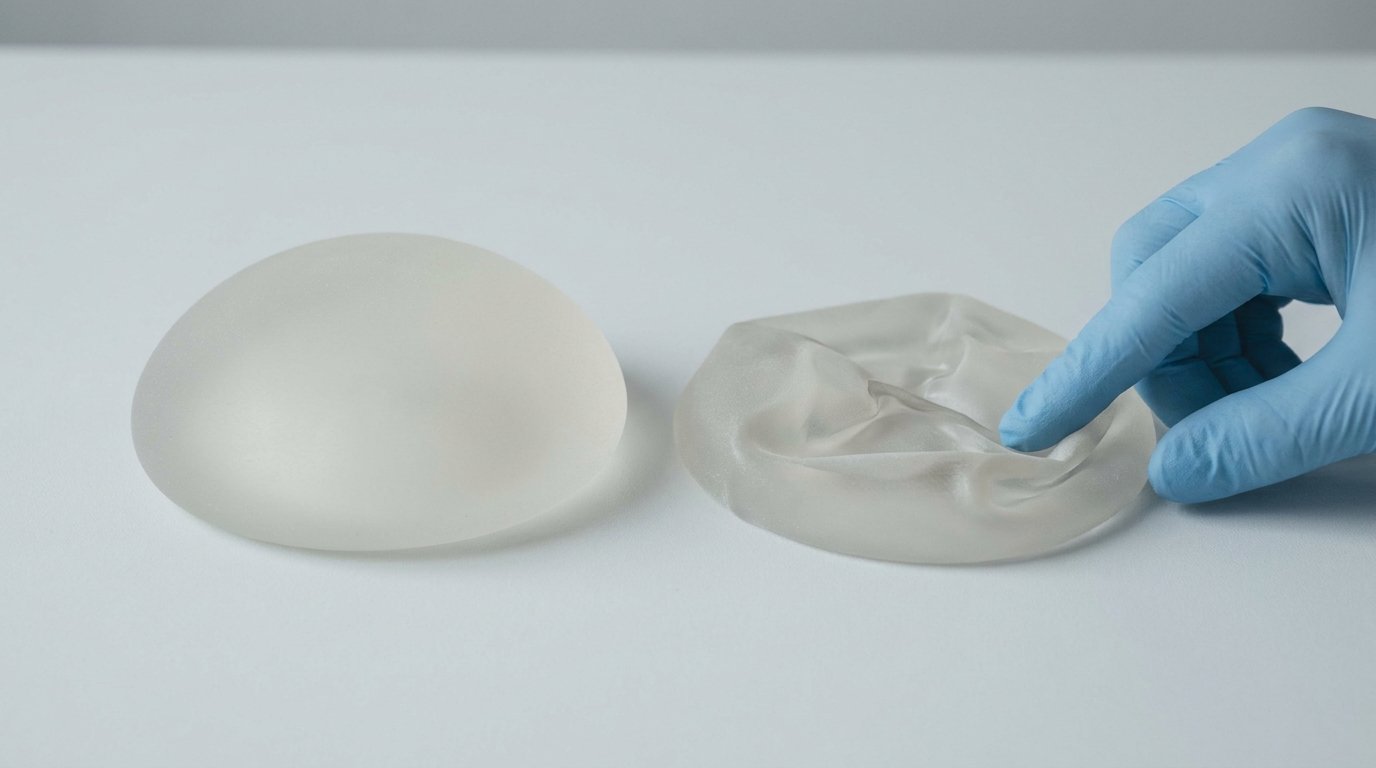
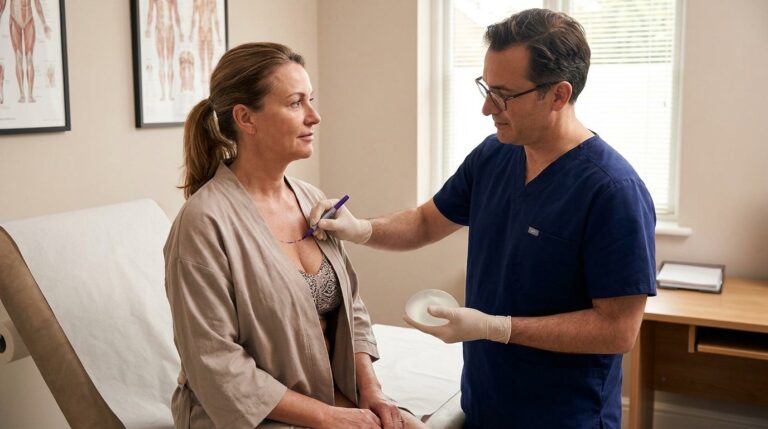
Your surgeon may examine the breast and recommend ultrasound or MRI depending on the implant type, your symptoms, and local practice. If you are exploring breast implant revision, this sort of assessment is usually the first step before discussing treatment.
Normal healing tends to improve over weeks and months. Capsular contracture tends to persist or worsen, often with hardening and visible distortion. Implant rupture can overlap with these symptoms, especially if shape changes suddenly, but rupture may also be silent. Imaging and an experienced breast surgeon help separate these possibilities.
When should you seek urgent review?
Capsular contracture is usually not an emergency, but some breast changes should be treated as time-sensitive. A breast that suddenly swells, becomes red and hot, or changes shape quickly needs proper assessment. The same is true if you feel generally unwell, develop fever, or notice a new persistent lump.
There is also a specific late complication that surgeons keep in mind with implants: a delayed fluid collection around the implant. This is uncommon, but it is one reason doctors do not like unexplained late swelling to be ignored.
Use common sense here. If a breast is steadily getting firmer over months, book a specialist review. If it changes dramatically over days, seek prompt care.
- ✓Sudden swelling on one side
- ✓Redness, warmth, or fever
- ✓Rapid increase in pain or tightness
- ✓A breast that quickly changes position or shape
- ✓A new lump or persistent fluid feeling
🚨 Do not wait on red-flag symptoms Rapid swelling, redness, fever, or a sudden shape change needs prompt medical assessment. These can suggest problems other than capsular contracture, including infection or bleeding.
Seek prompt medical review if you have sudden swelling, marked redness, fever, severe pain, a rapidly changing breast shape, or a new lump. These symptoms are not typical mild contracture and may point to infection, bleeding, rupture, or another complication that should be assessed without delay.
What treatment options are there if it is capsular contracture?
Treatment is not one-size-fits-all. If the breast is only mildly firm and you are not bothered by the look or feel, a surgeon may suggest monitoring rather than immediate surgery. Once the breast is painful, obviously distorted, or both, revision surgery becomes a more common discussion.
Broadly, surgery may involve removing the implant, replacing it, removing or releasing part of the capsule, or combining implant removal with reshaping. Which option suits you depends on breast tissue, skin quality, implant position, whether you want to stay the same size, and whether you want implants at all.
According to a 2022 study in Aesthetic Plastic Surgery, revision after unsatisfactory breast augmentation can be approached either by implant replacement or by explantation, meaning implant removal, and explantation may be combined with techniques to restore shape and volume. That matches real-world decision-making: some patients want another implant, while others prefer to remove implants and reshape the breast.
A 2013 study in Plastic and Reconstructive Surgery looked at autoaugmentation after implant removal in patients who did not want new implants. In simple terms, the surgeon uses the patient’s own breast tissue to improve shape after explant surgery. This is not right for everyone, but it is one of the reasons implant removal does not automatically mean accepting a flat or deflated result.
If you are also reviewing your original implant choices, it may help to read about breast augmentation and how revision goals differ from first-time surgery.
Often chosen when the patient wants to keep breast volume and remain implant-based.
Can suit patients who want to avoid future implant maintenance, especially if combined with reshaping.
May help restore contour when skin has stretched or breast tissue has thinned.
Treatment depends on severity, symptoms, and your goals. Mild cases may be observed, but significant firmness, pain, or distortion often leads to surgery. Options can include implant removal, implant replacement, and surgery on the scar capsule. Some patients also choose a lift or reshaping without new implants.
What affects the cost and travel planning for revision surgery?
Because this topic is about a complication rather than one fixed procedure, cost is best understood by what drives it. A straightforward implant removal is different from removal plus capsulectomy, implant replacement, a breast lift, imaging, pathology, or an overnight hospital stay. Travel costs and the need for a longer stay can also change the total.
If you are travelling to Turkey, plan around the fact that revision surgery is more individual than first-time augmentation. You may need pre-operative imaging, a more detailed consultation, and a longer local stay so the surgeon can review swelling, drains if used, and early wound healing before you fly home.
Many international patients ask for a quote before they travel, which is reasonable, but the most accurate price usually comes after a surgeon has reviewed your history, implant details, symptoms, and photos, and sometimes imaging as well. If you want to start that process, a consultation request is the usual first step.
📋 Price should be personalised A quote for capsular contracture treatment is usually tailored after consultation. The exact operation may change once the surgeon has assessed your symptoms and imaging.
There is no single standard price for capsular contracture treatment because the final cost depends on the operation needed, whether implants are replaced, whether a lift is added, the hospital setting, scans, aftercare, and length of stay. A personalised quote is usually confirmed after consultation and assessment.
How long is recovery after implant removal or replacement for contracture?
Recovery after revision for capsular contracture is often less predictable than recovery after first-time augmentation. Some patients feel better quickly because the tight, uncomfortable implant has been dealt with. Others have more swelling and soreness because revision surgery can be more involved.
A common pattern is a few days of significant tightness and fatigue, then gradual improvement over the first two weeks. If drains are used, movement can feel awkward at first. Desk work may be possible sooner than lifting, stretching, gym training, or sleeping comfortably on your side.
For health-tourism planning, it is sensible to allow enough time in Turkey for at least the immediate post-op review and any early dressing changes. Your surgeon will give the exact timeline, but revision patients often need more flexibility than someone having a simple, primary procedure.
The table below gives a realistic overview rather than a promise, because healing rates vary.
- ✓Ask how long you should stay in Turkey before flying home.
- ✓Ask whether drains are likely and how they affect travel.
- ✓Ask when you can shower, drive, lift luggage, and exercise.
- ✓Ask what follow-up is available once you are back home.
Recovery depends on the exact revision, but many patients need around one to two weeks away from normal daily demands and longer before full exercise. Travel patients should usually expect to stay long enough for early checks. Swelling improves gradually, while final shape can take several months.
How do you choose a safe surgeon or clinic for capsular contracture treatment?
This is one of those situations where the cheapest or quickest route can create more stress later. Capsular contracture is not just about changing an implant. The surgeon needs to work out whether the problem is truly contracture, whether imaging is needed, whether the implant should be replaced, and what shape you are likely to have after surgery.
A good consultation should cover trade-offs plainly. For example, removing implants without replacement may reduce future implant-related issues, but it may also leave loose skin or less upper fullness. Replacing implants may restore volume better, but it does not remove the fact that implants need long-term monitoring. Honest counselling is a good sign.
If you are comparing providers, look at surgeon credentials, revision case experience, hospital standards, and how follow-up is organised for overseas patients. You can review the team’s background on the surgeons page and learn more about the clinic before booking a consultation.
📋 Revision surgery needs careful expectation-setting The aim is improvement and safety, not perfection. Breasts that have had implants and revision surgery may not return to an untouched baseline.
Your consultation includes a full history, implant details, discussion of imaging, and more than one treatment option.
The surgeon explains limits as well as benefits, including what your breast may look like without replacement implants.
You are given a fixed plan or sales pressure before anyone has properly assessed your symptoms.
There is no clear aftercare plan for when you return home.
- →Choose a surgeon who regularly performs breast revision, not only primary augmentation.
- →Ask what tests or scans are needed before deciding on surgery.
- →Ask who provides out-of-country follow-up if you are travelling for treatment.
- →Ask what result is realistic with and without new implants.
Safety starts with the right assessment, not the fastest booking. Look for a qualified plastic surgeon with revision experience, clear consent, a realistic discussion of options, and a plan for aftercare. Capsular contracture surgery can be more complex than first-time augmentation, so experience in revision work matters.
What is the practical next step if you think you have capsular contracture?
Take clear photos from the front and side, note when the change started, and write down any symptoms such as firmness, pain, tightness, visible asymmetry, or a breast sitting higher. If you know your implant type, placement, and surgery date, keep that information ready too. It helps the surgeon understand whether your changes fit a likely pattern.
From there, book a proper review with a qualified plastic surgeon. You may be advised to have imaging before any decision is made. That can feel like an extra step, but it often prevents the wrong treatment.
If capsular contracture is confirmed, the real question is not simply “Can it be fixed?” but “Which option best fits my symptoms, anatomy, and long-term goals?” Some patients want to keep implants. Others want removal and a fresh start. The best plan is the one made after careful assessment, not guesswork.
This article is for informational purposes only and does not constitute medical advice. Always consult a qualified surgeon for personalised guidance.
Frequently Asked Questions
References
- 📎One-Stage Mastopexy-Lipofilling after Implant Removal in Cosmetic Breast Surgery — Aesthetic Plast Surg, 2022
- 📎Outcomes analysis of patients undergoing autoaugmentation after breast implant removal — Plast Reconstr Surg, 2013
- 📎Surgical Management of Breast Capsular Contracture-A Multi-institutional Data Analysis of Risk Factors for Early Complications — Aesthetic Plast Surg, 2025
- 📎NHS cosmetic procedures guidance
- 📎Mayo Clinic procedures guidance
Related Articles



You Might Also Like



Related articles


Our specialists
 Clineca SpecialistErkan PinegözPlastic & Reconstructive Surgery
 Clineca SpecialistHakan AktaşPlastic & Reconstructive Surgery
 Clineca SpecialistOrkun UzuneyüpoğluPlastic & Reconstructive Surgery
 Clineca SpecialistSalim İskenderPlastic & Reconstructive Surgery
 Clineca SpecialistEngin SelamioğluPlastic & Reconstructive Surgery
 Clineca SpecialistCem AydınPlastic & Reconstructive Surgery
 Clineca SpecialistAlperen ÖnalEar, Nose & Throat (ENT)